Twenty-nine years ago this week, a Canadian singer released a ballad that almost didn't make it into the movie it was written for. The director of Titanic did not want a pop song anywhere near his tragedy, the singer did not want to record it and the composer had to sneak a demo past both of them. A few months later, "My Heart Will Go On" was the best-selling single of 1998 worldwide, with an Oscar on the way and four Grammys to follow. It is a song so familiar that it can be hard to hear, so let's slow down and listen to how it was built and why it still lands. Song Facts Artist Celine Dion Released November 24, 1997 (international single); early 1998 in the United States Album Titanic: Music from the Motion Picture and Let's Talk About Love (both 1997) Written by James Horner (music) and Will Jennings (lyrics) Produced by Walter Afanasieff, James Horner and Simon Franglen Recorded 1997, at the Hit Factory in New York and WallyWorld in San Rafael, Cal...
Picture a 16-year-old in a gingham dress, leaning against a hay wagon on a soundstage painted to look like a dusty Kansas farm. Studio executives thought it was the dullest stretch of the picture and cut it more than once. Yet that quiet wish became the song that a national survey would one day name the greatest of the entire twentieth century. "Over the Rainbow" is proof that the smallest moment in a film can turn out to be the one that lasts the longest.
Song Facts
| Artist | Judy Garland |
| Released | August 1939 in the film The Wizard of Oz; Decca studio single in September 1939 |
| Album | The Wizard of Oz (Decca 78-rpm album of studio recordings); the film soundtrack version first appeared on MGM's 1956 album |
| Written by | Harold Arlen (music) and E. Y. "Yip" Harburg (lyrics) |
| Produced by | Film produced by Mervyn LeRoy with associate producer Arthur Freed; orchestration by Murray Cutter; Decca single with Victor Young and His Orchestra |
| Recorded | October 7, 1938, at MGM (film version); July 28, 1939 (Decca single) |
| Genre | Traditional pop, show tune, jazz standard |
| Length | About 2:45 (film version) |
| Peak Chart Position(s) | No. 1 on radio's Your Hit Parade in 1939 (song ranking) |
What the Song Is Really Saying
On the surface, the song is a simple daydream. Dorothy Gale has just been scolded and brushed aside by every adult on the farm, and she wonders aloud whether there is a place where trouble cannot follow her. She imagines a land far off and high up, where the sky stays blue and every hope is granted. Then the song turns on a single, aching question: if birds can cross that arc of color, why can't she?
Yip Harburg knew exactly what he wanted that image to carry. According to an essay published by the Library of Congress, he reasoned that for a girl stuck on a dry, gray Kansas farm, a rainbow would be the only splash of color she ever saw. That idea fit the film perfectly. The Kansas scenes were shot in sepia tones, while the Oz scenes burst into Technicolor, so the song works as a hinge between the drab world Dorothy knows and the vivid one she is about to enter.
Harold Arlen's melody does as much storytelling as the words. The opening leap of a full octave sounds like someone reaching for something just out of grasp, and the long, arching lines keep climbing as the wish grows bolder. The bridge, by contrast, is bouncy and almost childlike. Arlen reportedly built it from the feel of a simple piano exercise, which keeps the song rooted in the voice of a young girl rather than a grown torch singer.
Over the decades, listeners have heard far more in it than a farm girl's wish. During World War II, American troops in Europe adopted the song as a reminder of home, according to the Songwriters Hall of Fame. Garland herself gave perhaps the best summary. In a 1967 interview quoted by the Library of Congress, she said the song stood for "everyone's wondering why things can't be a little better."
Because the lyrics are protected by copyright, we don't reproduce them here. You can read and hear the song in full through licensed services such as Apple Music and Spotify, and you can learn more about Garland's life at the Judy Garland Museum in her hometown of Grand Rapids, Minnesota.
The Story Behind the Song
MGM hired Arlen and Harburg in 1938 to write the score for its lavish adaptation of L. Frank Baum's novel. The pair had a set routine: Harburg would propose a title or an idea tied to the plot, Arlen would compose the tune and Harburg would then fit words to it. For this spot, the film needed a ballad for a girl in trouble who longs to get away from Kansas. Arlen felt the idea called for a melody with a long, broad line, and finding one took time.
The breakthrough came on the way to the movies. As the story is usually told, Arlen was riding along Sunset Boulevard with his wife, Anya, when the tune arrived all at once. He asked her to pull over near Schwab's Drug Store and jotted it down on manuscript paper. Harburg was not convinced at first. He thought the melody sounded too grand and ornate for a Kansas farm girl. According to the Library of Congress essay, Ira Gershwin suggested that Arlen play it with a lighter, more rhythmic touch, and Harburg finally heard a child's song inside it.

Garland recorded the film version on October 7, 1938, just as shooting began, with an orchestration by Murray Cutter. The near-disaster came later. After early previews, studio executives decided that a slow ballad so early in the picture stalled the story, and the number was removed. Associate producer Arthur Freed, who had brought Arlen and Harburg to the project, fought to restore it. When it was cut again, he reportedly told the studio that either the song stayed or he would leave. Columbia News reports that studio chief Louis B. Mayer finally sided with Freed, and the scene survived.
The film reached theaters in August 1939. A few weeks before that, on July 28, 1939, Garland had gone into a Decca session to cut a separate studio version with Victor Young and His Orchestra, and it became a best seller. The film performance itself would not be sold on record until MGM's soundtrack album of 1956.
The Artist
Judy Garland was born Frances Ethel Gumm on June 10, 1922, in Grand Rapids, Minnesota. Her parents ran a theater, and by the age of two she was singing onstage with her older sisters in a vaudeville act later billed as the Gumm Sisters. MGM signed her in 1935, when she was 13, after a single audition. Her work in 1939 earned her a special Juvenile Academy Award.

Her adult career was dazzling and turbulent in equal measure. She earned an Academy Award nomination for Best Actress for A Star Is Born in 1954 and won a Golden Globe for the same role. Her April 23, 1961, concert became the album Judy at Carnegie Hall, which won four Grammy Awards, including Album of the Year. She was the first woman to win that prize. She sang "Over the Rainbow" for about 30 years, and it became her signature song. Columbia News notes that the song could feel like a burden to her as an adult, which she likened to being "a grandmother in pigtails," yet she never stopped performing it.
Garland's final American stage appearance came in 1968, at a Lincoln Center tribute to Arlen, where she joined the composer to sing the song one more time. She died in London on June 22, 1969, at the age of 47. The American Film Institute later ranked her eighth among the greatest female stars of classic Hollywood.
Awards and Records
- Academy Award: Arlen and Harburg won the Oscar for Best Original Song at the ceremony held in early 1940.
- Grammy Hall of Fame: Garland's 1939 Decca recording was inducted in 1981.
- Songs of the Century: A 2001 survey by the Recording Industry Association of America and the National Endowment for the Arts ranked it No. 1 among the songs of the twentieth century.
- AFI's 100 Years...100 Songs: The American Film Institute named it the greatest song in American film history in 2004.
- Songwriters Hall of Fame: It received the Towering Song Award in 2014.
- National Recording Registry: The Library of Congress added Garland's 1939 single to the registry in its 2016 class, announced in March 2017.
- Your Hit Parade: The Library of Congress essay reports that the song spent 15 weeks on the radio countdown in 1939, seven of them at No. 1.
Covers and Remakes
The song began collecting covers almost immediately. Glenn Miller and his orchestra recorded it in 1939. The doo-wop group the Demensions took it to No. 16 on the Billboard Hot 100 in 1960, and Jerry Lee Lewis turned it into a country hit in 1980. In 2006, American Idol finalist Katharine McPhee reached No. 12 on the Hot 100 with her version. Ariana Grande sang it at the One Love Manchester benefit in 2017 and opened the 97th Academy Awards with it in 2025.
The most beloved remake came from Hawaii. In 1988, Israel Kamakawiwo'ole called a Honolulu studio at around 3 a.m. and asked to record. Engineer Milan Bertosa gave him 15 minutes to get there, and the singer cut a gentle ukulele medley of "Over the Rainbow" and "What a Wonderful World" in a single take. It reached a wide audience on his 1993 album Facing Future and spread through films and television. It eventually topped the charts in Germany and France and earned a Platinum certification in the United States. Eva Cassidy's hushed version, released after her death, became a Gold seller in the United Kingdom.

Legacy and Influence
Few songs have traveled so far from their original purpose. It was written as a plot device to get a girl from Kansas to Oz, and it became a wartime keepsake, a jazz standard, a concert closer and a lullaby that parents still sing at bedtime. That durability is a tribute to Arlen's long, singable line and to Harburg's choice of one clear, universal image.
According to Smithsonian magazine, the Library of Congress's Harold Arlen Collection now includes Harburg's only known pencil sketch of the lyric on a scrap of yellow legal paper. That draft shows him trying out a darker image before settling on the hopeful one the world knows.
Above all, "Over the Rainbow" belongs to Judy Garland, the teenager who sang it as if the wish were her own. Play it again tonight, and listen for the moment her voice climbs that first octave, reaching for a better place that every listener has imagined at least once.
Sources
- "Over the Rainbow"—Judy Garland (1939), essay by Walter Rimler, Library of Congress National Recording Registry
- National Recording Registry Picks Are "Over the Rainbow," Library of Congress
- "Over the Rainbow": The Story Behind the Song of the Century, Columbia News
- "Over the Rainbow," Songwriters Hall of Fame
- Want to See the Original Lyrics for "Over the Rainbow"? All You Need Is a Library Card, Smithsonian Magazine
Image Credits
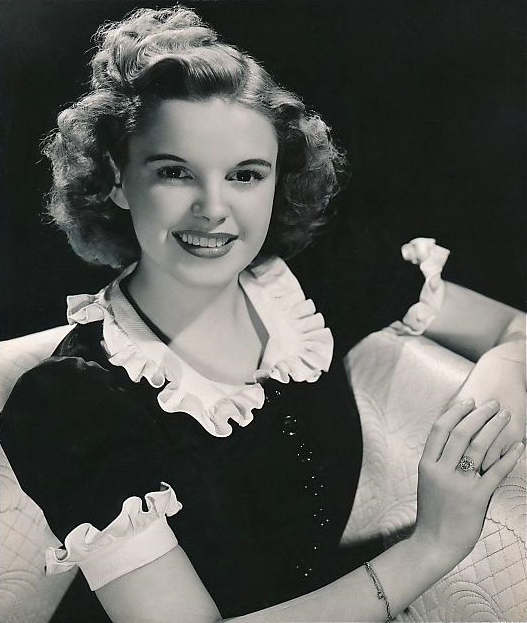
- Judy Garland publicity portrait, 1939. Photo: Metro-Goldwyn-Mayer, public domain, via Wikimedia Commons.
- Portrait of Harold Arlen, 1960. Photo: Carl Van Vechten, public domain, via Wikimedia Commons.
- Judy Garland Museum birthplace, Grand Rapids, Minnesota, 2023. Photo: Myotus, CC BY-SA 4.0, via Wikimedia Commons.
- Judy Garland's signature at Grauman's Chinese Theatre, 2010. Photo: NativeForeigner, public domain, via Wikimedia Commons.
Comments
Post a Comment