Most protest songs shout. "What's Going On" leans in close and asks a question, almost in a whisper, over a saxophone line that sounds like a warm-up. That gentleness is exactly why it lasts. In 1971, Marvin Gaye was Motown's smoothest romantic voice, the man behind sweet duets and radio-ready heartbreak. Then he walked into the studio and made a record about war, police violence and a country at odds with its own children. His label boss thought it was a career-ending mistake. Instead, it became a smash, the foundation of an album now often named the greatest ever made and a song people still reach for whenever the news turns dark. Song Facts Artist Marvin Gaye Released January 1971 (Tamla) Album What's Going On (released May 21, 1971) Written by Renaldo "Obie" Benson, Al Cleveland and Marvin Gaye Produced by Marvin Gaye Recorded June 1, 1970, with overdubs into September, at Hitsville U.S.A., Detroit Genre Soul, R&B Length 3:53 (album v...
Losing My Religion by R.E.M.: The Meaning, the Story, and the Five-Minute Mandolin Riff That Made a Cult Band Superstars
Picture a guitarist sitting in front of the television one night in 1990, noodling on a mandolin he has barely learned to play. He records a few minutes of a nervous, circling riff onto tape and thinks little of it. Within a year, that riff would carry a cult band from Athens, Georgia, to the top of the Billboard album chart, win two Grammys and six MTV awards, and turn a strange Southern figure of speech into one of the most quoted song titles of the 1990s. "Losing My Religion" is the song that made R.E.M. superstars, and it did so with an instrument rarely heard leading a rock single.
Song Facts
| Artist | R.E.M. |
| Released | February 19, 1991 (Warner Bros. Records) |
| Album | Out of Time (1991) |
| Written by | Bill Berry, Peter Buck, Mike Mills and Michael Stipe |
| Produced by | Scott Litt and R.E.M. |
| Recorded | September to October 1990, Bearsville Studios (Woodstock, New York), with strings added in Atlanta |
| Genre | Alternative rock, folk rock |
| Length | 4:28 |
| Peak chart positions | No. 4 on the US Billboard Hot 100; No. 1 on Billboard's Modern Rock Tracks for eight weeks; No. 19 in the UK |
What the Song Is Really Saying
The first thing to know is that the song is not about faith, at least not in the way the title suggests. In parts of the American South, "losing my religion" is an old expression for reaching the end of your rope. It describes the moment when patience runs out and good manners start to crack. Michael Stipe, who was born in Georgia, borrowed the phrase precisely because it captured that feeling of being pushed past polite composure.
What pushes the narrator there is love, or rather love that is not returned. Stipe has described the song as being about romantic longing and unrequited desire. The narrator watches someone from a distance, replays every small gesture and wonders whether a hint was noticed or ignored. He feels exposed, worried that he has revealed far too much of himself, and then just as quickly fears he has not revealed enough. The lyric swings between boldness and retreat, just as a crush does.
Stipe has compared the song to the Police's "Every Breath You Take," calling both of them classic obsession pop songs. Like Sting's hit, "Losing My Religion" is gorgeous on the surface and slightly unsettling underneath, and the tension between the pretty sound and the uneasy feeling is a big part of why the song never wears out.
Over the years, listeners have also heard other meanings in it. Many people still take it as a song about doubt or a crisis of belief, an interpretation the striking religious imagery of the music video did nothing to discourage. Stipe himself has preferred to leave room for those readings. In a 1992 Rolling Stone interview quoted by the band's official site, he said that the best songs are ones that anybody can listen to and find themselves in. During R.E.M.'s MTV Unplugged appearance, he even told the audience that the song was about them.
Because the lyrics are protected by copyright, we have not quoted them here. You can read them alongside the recording on licensed services such as Apple Music or Spotify, and find much more about the band on the official R.E.M. site at remhq.com.
The Story Behind the Song
By 1990, Peter Buck had recently taken up the mandolin, and he had carried one on the road during the tour for Green, the band's 1988 major-label debut. According to Stereogum's history of the song, the main riff arrived one evening while Buck was watching television with the mandolin in his lap. He taped what he played and brought it to the band. Buck later said the music came together in roughly five minutes, and that it was the first song R.E.M. wrote specifically for the new album. He has said he probably would not have found the same chords on a guitar.
The band shaped the idea quickly. A demo made in Athens in the summer of 1990, under the working title "Sugar Cane," featured banjo and organ. Mike Mills wrote a bass line that he felt owed something to Fleetwood Mac's John McVie, and Peter Holsapple, the band's touring guitarist at the time, added acoustic guitar to fill the space between the low bass and the high, chattering mandolin. Stipe reportedly wrote his words in under an hour.

The finished track was recorded with producer Scott Litt in the fall of 1990, mainly at Bearsville Studios near Woodstock, New York. Members of the Atlanta Symphony Orchestra later added a string arrangement by Mark Bingham, giving the song its sweeping, almost cinematic swell. Stipe sang his vocal in a single take. Warner Bros. was reportedly wary of a mandolin-led single and pitched it first to college and rock radio before Top 40.
Then came the video. Director Tarsem Singh, then a little-known filmmaker who had made clips for En Vogue and Suzanne Vega, pitched something far stranger than the simple performance piece Stipe had in mind. Singh drew on the dreamlike style of Indian cinema, the paintings of Caravaggio, Andrei Tarkovsky's film The Sacrifice and Gabriel García Márquez's short story "A Very Old Man with Enormous Wings." The result was a lush, theatrical clip filled with saints, angels and tableaux. It also marked the first time Stipe agreed to lip-sync in an R.E.M. video.
The Artist
R.E.M. formed in Athens, Georgia, in 1980, when singer Michael Stipe, guitarist Peter Buck, bassist Mike Mills and drummer Bill Berry began playing parties and small clubs around the University of Georgia. Their 1981 single "Radio Free Europe" won over critics, and their 1983 debut album, Murmur, released on the independent label I.R.S. Records, was named album of the year by Rolling Stone. Over the course of the 1980s, they became the defining act of American college radio.

After signing with Warner Bros., R.E.M. grew steadily bigger, but Out of Time took them to an entirely new level. The album reached No. 1 on the Billboard 200 in 1991, and its follow-up, Automatic for the People, cemented their place among the biggest bands in the world. Bill Berry left in 1997, two years after surviving a brain aneurysm on tour, and the other three carried on until September 2011, when they announced that they were ending the band. By then, according to the New Georgia Encyclopedia, they had sold more than 70 million records.
The band was inducted into the Rock and Roll Hall of Fame in 2007. In June 2024, when R.E.M. entered the Songwriters Hall of Fame in New York, all four original members surprised the audience by performing as R.E.M. for the first time in 15 years. Fittingly, the song they chose was a stripped-down "Losing My Religion," with Buck back on mandolin.

Awards and Records
- Grammy Awards: At the 1992 ceremony, the song won Best Pop Performance by a Duo or Group with Vocal and Best Short Form Music Video, and it was also nominated for Record of the Year and Song of the Year.
- MTV Video Music Awards: The video earned nine nominations in 1991 and won six, including Video of the Year, Best Group Video and Best Direction.
- Billboard charts: It peaked at No. 4 on the Hot 100, the band's highest-charting US single, and spent eight weeks at No. 1 on Modern Rock Tracks.
- International success: The single reached No. 1 in the Netherlands and Belgium and the top five in France, Sweden and Norway.
- Grammy Hall of Fame: The recording was inducted in 2017, alongside songs by Nirvana and David Bowie.
- YouTube milestone: In 2020, the official video became the first R.E.M. clip to pass one billion views.
- Critical rankings: It has appeared on Rolling Stone's list of the 500 Greatest Songs of All Time and placed second, behind Nirvana's "Smells Like Teen Spirit," in the Village Voice's 1991 Pazz & Jop critics' poll.
Covers and Remakes
The song's simple chord pattern and memorable riff have made it a favorite for reinterpretation. Tori Amos recorded a hushed, piano-led version in 1995 for the soundtrack of the film Higher Learning. In 2010, Cory Monteith, as Finn Hudson, sang it in an episode of Glee about faith, and that version reached the Billboard Hot 100 on its own. Trivium, Soccer Mommy and Hootie & the Blowfish have also covered it.
One of the most memorable live versions involved Stipe himself: in 2012, he sang it with Coldplay's Chris Martin at a Madison Square Garden benefit for Hurricane Sandy relief.
Legacy and Influence
"Losing My Religion" arrived just months before Nirvana's Nevermind, and together the two records helped prove that music from the college-radio underground could dominate the mainstream. R.E.M. had spent a decade building a loyal following without compromising, and this single showed that an odd, mandolin-driven ballad about longing could become a worldwide hit on its own terms. Mike Mills has suggested that without it, Out of Time would have sold only a fraction of what it eventually did.
The song also changed what a rock hit could sound like. A mandolin replaced the electric guitar as the lead voice, and the singer admitted to doubt instead of swagger. More than three decades on, the song still fills radio playlists and streaming services around the world.
Put it on again and listen to that restless mandolin, a riff that began as a few idle minutes in front of a television and became the sound of wanting someone far too much.
Sources
- 20 Years of Losing My Religion (R.E.M.HQ, official band site)
- The Alternative Number Ones: R.E.M.'s "Losing My Religion" (Stereogum)
- R.E.M. reunites for the first time in 15 years, performs 'Losing My Religion' (NPR)
- R.E.M.'s 'Losing My Religion' Video Reaches A Billion Views On YouTube (uDiscover Music)
- R.E.M. (New Georgia Encyclopedia)
Image Credits
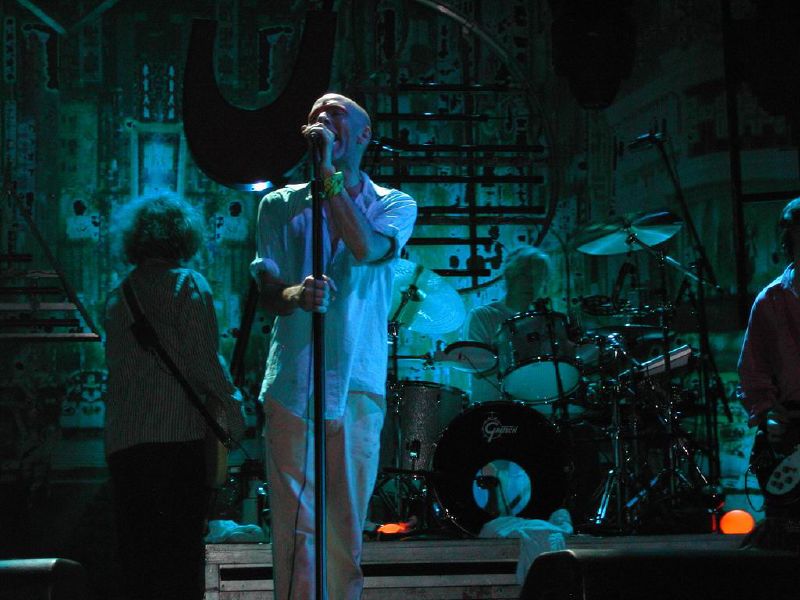
- R.E.M. in concert, Padua, 2003: Stefano Andreoli (Flickr user Stark), CC BY-SA 2.0, via Wikimedia Commons.
- Peter Buck on stage, Padua, 2003: Flickr user Stark!, CC BY-SA 2.0, via Wikimedia Commons.
- Michael Stipe at Bilbao BBK Live, 2008: Alberto Cabello, CC BY 2.0, via Wikimedia Commons.
- Murmur railroad trestle, Athens, Georgia, 2018: Michael Rivera, CC BY-SA 4.0, via Wikimedia Commons.
Comments
Post a Comment