Twenty-nine years ago this week, a Canadian singer released a ballad that almost didn't make it into the movie it was written for. The director of Titanic did not want a pop song anywhere near his tragedy, the singer did not want to record it and the composer had to sneak a demo past both of them. A few months later, "My Heart Will Go On" was the best-selling single of 1998 worldwide, with an Oscar on the way and four Grammys to follow. It is a song so familiar that it can be hard to hear, so let's slow down and listen to how it was built and why it still lands. Song Facts Artist Celine Dion Released November 24, 1997 (international single); early 1998 in the United States Album Titanic: Music from the Motion Picture and Let's Talk About Love (both 1997) Written by James Horner (music) and Will Jennings (lyrics) Produced by Walter Afanasieff, James Horner and Simon Franglen Recorded 1997, at the Hit Factory in New York and WallyWorld in San Rafael, Cal...
Hotel California by Eagles: The Meaning, the Story, and the Mexican Reggae Demo That Became a Rock Legend
It opens with a twelve-string guitar, a slow bass line and a drumbeat that seems to sway in the heat. For nearly a minute, nobody sings. Then Don Henley's voice arrives, tired and watchful, and a song that one of the Eagles' own guitarists thought was far too long for radio would go on to top the Billboard Hot 100, win the Grammy for Record of the Year and become one of the most argued-about stories in rock. "Hotel California" is six and a half minutes of glamour and dread, and almost fifty years later, people are still trying to figure out where the hallway leads.
Song Facts
| Artist | Eagles |
| Released | December 8, 1976 (album); February 1977 (single) |
| Album | Hotel California (Asylum Records) |
| Written by | Don Felder (music), Don Henley and Glenn Frey (lyrics) |
| Produced by | Bill Szymczyk |
| Recorded | 1976, Record Plant (Los Angeles) and Criteria Studios (Miami) |
| Genre | Rock |
| Length | 6:30 (album); 6:08 (single) |
| Peak Chart Positions | No. 1 US Billboard Hot 100; No. 1 Canada; No. 8 UK |

What the Song Is Really Saying
On the surface, "Hotel California" is a short story. A tired traveler, driving through the desert at night, spots a glow far down the road and pulls over for the evening. A woman greets him at the door, the hotel is beautiful, and the guests seem to be having the time of their lives. Little by little, though, the place turns strange. The parties feel compulsive, the luxury feels like a trap, and when the narrator finally decides to go home, he learns that leaving is not really an option.
The band has never pretended the hotel is a real building. Glenn Frey said he and Henley wanted the song to open like an episode of The Twilight Zone, with an ordinary person stepping into an unsettling world, and he named John Fowles's novel The Magus, a book full of illusions and mind games, as an influence. Henley has described the song as a journey from innocence to experience. In a 2016 interview with CBS News, he said it was really about America more than California, calling it a look at "the dark underbelly of the American dream," with excess, narcissism and the music business all part of the picture.
That last point matters. By 1976, the Eagles were among the biggest bands in the world, and they had seen up close how fame, money and the Los Angeles party scene could swallow people whole. Many listeners hear the hotel as a portrait of that life: dazzling outside, hollow inside and hard to leave. Henley has said the Beverly Hills Hotel became a kind of symbol for what Los Angeles meant to the band at the time.
Other readings have piled up over the decades. Some critics hear a lament for the idealism of the 1960s, which, by the mid-1970s, seemed to have dissolved into disco, cocaine and corporate rock. Henley has generally shrugged off the more literal theories, dismissing one popular interpretation of a lyric as a misreading and insisting the song is a sociopolitical statement. He has also said it can carry a million interpretations, which may be the most honest answer of all.
The lyrics are well worth reading in full alongside the music. You can stream the song on Apple Music or Spotify, where licensed lyrics are displayed, and learn more about the band at the official Eagles website.
The Story Behind the Song
The music came first, and it came from Don Felder. Felder had joined the Eagles in 1974 and made a habit of recording instrumental demos for Henley and Frey to write words over. He sketched this one in a rented house on Malibu Beach, playing a twelve-string guitar over a Rhythm Ace drum machine on a four-track recorder and adding a bass line afterward. The result had a lilting, Latin-tinged groove. When Henley heard it, he said it sounded like a Mexican reggae or bolero piece, and "Mexican Reggae" became the song's working title.
According to Louder, Henley listened to the cassette while driving around Los Angeles, and Felder has credited Frey with the original idea of a mysterious hotel. Henley then shaped most of the words. The same feature reports that the two songwriters even went to see Neil Simon's play California Suite in May 1976 as a kind of field research, only to decide that it was far too light for what they had in mind.
Recording the track took real stamina. Sessions for the album ran from March to October 1976 and moved between the Record Plant in Los Angeles and Criteria Studios in Miami. Felder had written the song in E minor, which turned out to be too high for Henley, so the band tried several keys before settling on B minor and recording it again. The final master was assembled from the best sections of several complete takes. Producer Bill Szymczyk later said there were 33 edits on the two-inch tape.
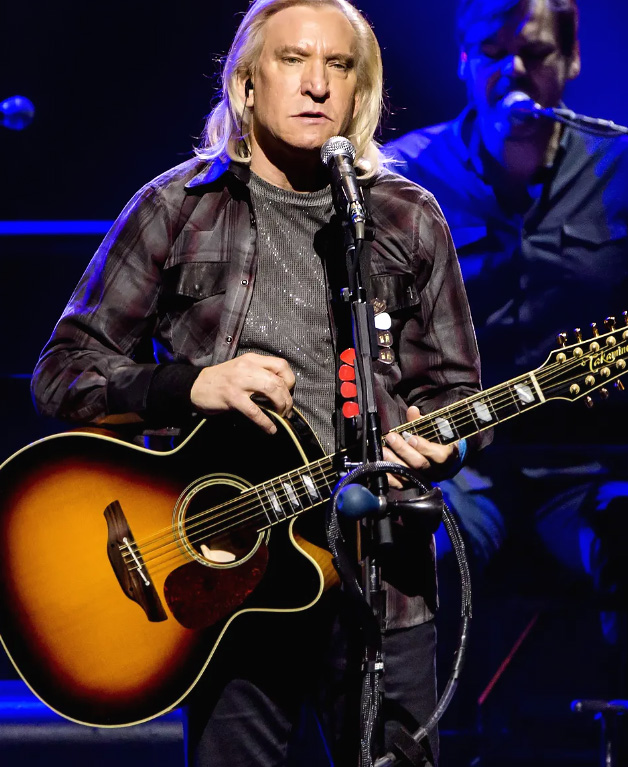
The famous closing solo was its own project. Felder and Joe Walsh, who had joined the band in 1975 after Bernie Leadon left, trade lines and then lock into twin harmonies over the final minutes. Henley wanted the guitar part to follow Felder's original demo closely, which reportedly forced Felder to track down his old tape and relearn what he had played. Once the song was finished, Asylum Records worried about its length, and Felder himself thought it was too long for AM radio. Henley insisted on releasing it as a single anyway. It followed "New Kid in Town" in early 1977 and reached No. 1 on the Billboard Hot 100 in May of that year, the band's fourth chart-topper.

The Artist
The Eagles formed in Los Angeles in 1971 and became the defining sound of 1970s Southern California rock, blending country harmonies with sharp, polished songwriting. Early hits such as "Take It Easy" and "Desperado" built their reputation, while the arrivals of Felder and Walsh pushed the group toward a harder, more electric sound. Hotel California was Walsh's first album with the band and the last with founding bassist Randy Meisner, who left in 1977 and was replaced by Timothy B. Schmit.
At the center of it all were Henley and Frey, the drummer and the guitarist who wrote most of the band's best-known songs. Henley, a Texan with a precise, slightly rough tenor, sang lead on "Hotel California" while also playing drums. The pressures the song describes were not abstract to them. The band split acrimoniously in 1980, reunited in 1994 for the aptly named Hell Freezes Over tour and album, and kept touring for decades. Frey died in 2016, and the band later continued with Henley, Walsh, Schmit and newer members.

The album itself became one of the best-selling records in American history. It spent eight nonconsecutive weeks at No. 1 on the Billboard 200, and in January 2026, the RIAA certified it 28 times platinum.
Awards and Records
- Grammy Award: Record of the Year at the 20th Annual Grammy Awards in 1978, beating songs by Linda Ronstadt, Crystal Gayle, Barbra Streisand and Debby Boone. The band did not attend the ceremony.
- Grammy Hall of Fame: Inducted in 2003.
- Billboard Hot 100: Reached No. 1 for one week in May 1977, the Eagles' fourth chart-topping single.
- Rolling Stone: Ranked No. 49 on the magazine's 2004 list of the 500 Greatest Songs of All Time.
- Rock and Roll Hall of Fame: Named one of the 500 Songs That Shaped Rock and Roll.
- Guitar solo: Voted the best guitar solo of all time by readers of Guitarist magazine in 1998.
Covers and Remakes
The most famous alternate version belongs to the Eagles themselves. For the 1994 Hell Freezes Over reunion, they rebuilt the song as an acoustic number, with Felder opening it on a nylon-string Spanish guitar introduction. In 1990, the Gipsy Kings recorded a fiery Spanish-language flamenco version for an Elektra Records anniversary compilation, and that recording later turned up in the Coen brothers' film The Big Lebowski, a movie whose main character famously dislikes the Eagles.
The song has drawn a wide range of other artists. Christina Aguilera performed it on The Voice, the Killers recorded it with the Latin collective Rhythms del Mundo, and bands from Romania, Australia and the Czech Republic have recorded their own versions. Not every reuse was welcomed. When Frank Ocean built his 2011 track "American Wedding" on the original instrumental, Henley threatened legal action, a reminder of how closely the band guards its signature song.
Legacy and Influence
"Hotel California" has become shorthand for any place, job or relationship that is easy to enter and hard to escape. In 1998, at the Eagles' induction into the Rock and Roll Hall of Fame, all seven past and present members performed it together, the only time that lineup ever shared a stage. The song has also had a strange afterlife. Henley's handwritten lyric drafts for the album, including this song, became the center of a criminal case in New York, where three men were charged in 2022 with conspiring to sell manuscripts that Henley said had been stolen from him. Prosecutors dropped the case midtrial in March 2024.
Musicians still study it. The chord progression, which echoes the descending pattern heard in flamenco, is a staple for many guitar students, and the twin-guitar coda remains a benchmark for how two players can build a solo together. Jethro Tull's Ian Anderson once noted that the chords resemble an earlier song of his, but he framed it as a joke rather than an accusation. The song endures because it never resolves its own mystery. Put it on tonight, wait for that twelve-string to start, and see whether the place lets you go before the final guitar fades.
Sources
- The story behind the Eagles "spooky" classic Hotel California, Louder
- What does "Hotel California" really mean? (And other questions for Don Henley), CBS News
- Behind the Song: The Eagles, "Hotel California," American Songwriter
- Record Of The Year 1978 Winners & Nominees, GRAMMY.com
- The Eagles—All Seven of Them—Perform "Hotel California" in 1998, Guitar World
Image Credits
- The Eagles in concert, Vancouver, 2010: Linc-o, CC BY 2.0, via Wikimedia Commons.
- The Beverly Hills Hotel, 2013: Alan Light, CC BY 2.0, via Wikimedia Commons.
- Don Henley, 2000: John Mathew Smith & www.celebrity-photos.com, CC BY-SA 2.0, via Wikimedia Commons.
- Joe Walsh, 2019: Derek Russell, CC BY-SA 2.0, via Wikimedia Commons.
Comments
Post a Comment