Twenty-nine years ago this week, a Canadian singer released a ballad that almost didn't make it into the movie it was written for. The director of Titanic did not want a pop song anywhere near his tragedy, the singer did not want to record it and the composer had to sneak a demo past both of them. A few months later, "My Heart Will Go On" was the best-selling single of 1998 worldwide, with an Oscar on the way and four Grammys to follow. It is a song so familiar that it can be hard to hear, so let's slow down and listen to how it was built and why it still lands. Song Facts Artist Celine Dion Released November 24, 1997 (international single); early 1998 in the United States Album Titanic: Music from the Motion Picture and Let's Talk About Love (both 1997) Written by James Horner (music) and Will Jennings (lyrics) Produced by Walter Afanasieff, James Horner and Simon Franglen Recorded 1997, at the Hit Factory in New York and WallyWorld in San Rafael, Cal...
A Change Is Gonna Come by Sam Cooke: The Meaning, the Story, and the Anthem He Performed Live Only Once
On October 8, 1963, one of the most famous singers in America was turned away from a Louisiana motel and then arrested for complaining about it. A few months later, he walked into a Hollywood studio and recorded a song that made no complaint at all. It simply told the truth about waiting, and then promised that the waiting would end. Sam Cooke performed "A Change Is Gonna Come" on television once, never performed it again and did not live to see it become a single. Today it is one of the most honored American recordings ever made, a song that moved from a B-side to the Library of Congress to the victory speech of the first Black president of the United States.
Song Facts
| Artist | Sam Cooke |
| Released | Early 1964 (album); December 22, 1964 (single, as the B-side of "Shake") |
| Album | Ain't That Good News (RCA Victor) |
| Written by | Sam Cooke |
| Produced by | Hugo & Luigi (Hugo Peretti and Luigi Creatore); arranged and conducted by René Hall |
| Recorded | January 30, 1964, RCA Studios, Hollywood, California |
| Genre | Soul, R&B |
| Length | 3:11 (album version); 2:36 (single edit) |
| Peak Chart Positions | No. 9 Billboard R&B Singles; No. 31 Billboard Hot 100 (1965) |
What the Song Is Really Saying
The song opens at the very beginning of a life. The narrator tells us he was born beside a river and has been moving restlessly ever since, the way the water does. This is not a marching chant. It is a quiet autobiography, sung by someone who has spent his whole life in motion and still has not arrived anywhere that feels safe.
The second verse turns toward mortality. The singer admits that living has been hard but that dying frightens him too, because he has no idea what waits on the other side. It is a startling confession for a pop record in 1964. Cooke had grown up in the church and spent six years as a gospel star, and the verse carries the weight of a spiritual song without offering the usual comfort of heaven. Some listeners hear personal grief in it as well, since Cooke's infant son, Vincent, had drowned in 1963.
Then the song names the problem directly. In the third verse, the narrator describes going to a movie theater and being sent away, and walking downtown only to be warned off. Those are the everyday mechanics of segregation, and Cooke had lived them on the road for years. The bridge is the bleakest moment of all: he goes to his brother for help, and instead of support he is knocked back down to his knees. Listeners have heard that brother as a fellow citizen or as a nation that refused to act, and Cooke never said which.
Against all of that, the refrain refuses to give up. Every chorus insists that change has been slow, painfully slow, but that it will come. He sings the promise with a calm, almost weary certainty, as if he has already seen the end of the road and is simply reporting back. That balance of exhaustion and faith is what separates the song from most protest music of its era. It does not argue. It testifies.
Because the words are protected by copyright, we do not reprint them here. You can read and hear the full song on licensed services such as Apple Music or Spotify, and you can learn more about Cooke's catalog from his longtime label and publisher, ABKCO.
The Story Behind the Song
Two moments in 1963 pushed Cooke toward this song. The first was hearing Bob Dylan's "Blowin' in the Wind." According to Cooke's biographer Peter Guralnick, Cooke was struck that a young white folk singer had written such a powerful song about racial injustice, and he felt he should have been the one to write it. He began performing Dylan's song in his own shows, and he started thinking about what his version of that statement might sound like.
The second moment was personal and humiliating. On October 8, 1963, Cooke, his wife, Barbara, and members of his touring party arrived at the Holiday Inn North in Shreveport, Louisiana, where Cooke had reserved rooms by phone. The desk clerk told them nothing was available. When Cooke and his brother Charles protested, the group eventually drove away, but police caught up with them at the Black-owned Castle Hotel and arrested them for disturbing the peace. More than five decades later, in 2019, Shreveport's mayor formally apologized to Cooke's family.
Cooke wrote the song in late 1963, and those close to him later said it seemed to arrive almost fully formed. He handed it to René Hall, a Louisiana-born arranger he trusted, just days before the session and reportedly gave him no instructions at all. Hall wrote an orchestral score unlike anything else in Cooke's catalog, with sweeping strings, a French horn and booming timpani. On January 30, 1964, Cooke recorded it at RCA's studio in Hollywood with Hall conducting and a band that included New Orleans drummer Earl Palmer and keyboardist Harold Battiste.
Cooke seemed almost wary of what he had made. When he first played it for his protégé Bobby Womack, the younger singer reportedly said it "sounds like death," and Cooke agreed that it felt that way to him too. He sang it on The Tonight Show on February 7, 1964, but that broadcast was soon overshadowed by the Beatles' debut on The Ed Sullivan Show two days later, and the tape was not preserved. Guralnick has suggested that Cooke never performed it again partly because the arrangement was too elaborate to recreate on tour and partly because the song felt so ominous. RCA released an edited version as a single on December 22, 1964, less than two weeks after Cooke was killed in Los Angeles at the age of 33.
The Artist
Sam Cooke was born on January 22, 1931, in Clarksdale, Mississippi, and grew up in Chicago, where his father was a minister. In 1950, he became the lead singer of the Soul Stirrers, one of the most respected gospel groups in America, and his smooth, effortless tenor made him a star on the gospel circuit. Crossing over to pop was a real risk for a gospel star, but in 1957 Cooke released "You Send Me," which went to No. 1 on both the pop and R&B charts.

In all, Cooke placed 29 singles in the Billboard Top 40, including "Chain Gang," "Cupid," "Twistin' the Night Away," "Bring It On Home to Me" and "(What a) Wonderful World." He was also a pioneer behind the scenes. With his friend J. W. Alexander, he co-founded SAR Records in 1959 and ran his own publishing company, giving him a level of ownership over his music that very few Black artists of his generation enjoyed. His friends included Muhammad Ali and Malcolm X.
That career ended abruptly on December 11, 1964, when Cooke was shot and killed at the Hacienda Motel in Los Angeles. A coroner's jury ruled the shooting a justifiable homicide, but many of his family members and admirers have never accepted the official account. In 1986, he was inducted into the Rock and Roll Hall of Fame as part of its very first class, and he joined the Songwriters Hall of Fame a year later.

Awards and Records
- Chart run: The edited single reached No. 9 on the Billboard R&B chart and No. 31 on the Hot 100 in early 1965, months after Cooke's death.
- National Recording Registry: The Library of Congress added the recording to its 2006 National Recording Registry, recognizing it as an anthem of the civil rights movement.
- Rolling Stone's 500 Greatest Songs of All Time: It ranked No. 12 in 2004 and climbed to No. 3 in the 2021 update.
- Rolling Stone's 100 Best Protest Songs of All Time: The magazine placed it at No. 1 on its 2025 list.
- Songwriters Hall of Fame: It received the Towering Song Award in 2013, an honor given to songs with lasting cultural impact.
- Critics' lists: Pitchfork ranked it No. 3 among the 200 greatest songs of the 1960s, and NPR included it in its list of the most important American musical works of the 20th century.
- Certification: In the United Kingdom, the BPI has certified the recording Gold.
Covers and Remakes
The song has been recorded more than 500 times, according to its publisher, ABKCO. Otis Redding cut a version for his 1965 album Otis Blue, only months after Cooke's death, and Aretha Franklin recorded it in 1967 for I Never Loved a Man the Way I Love You, opening it with a new gospel-style introduction. Later generations kept returning to it, from Seal's 2008 recording to Beyoncé's live performances in 2013 and Jennifer Hudson's rendition at the 2020 Democratic National Convention.
Some of the most memorable versions arrived at public turning points. Before Barack Obama's 2009 inauguration, Bettye LaVette and Jon Bon Jovi sang it as a duet at the Lincoln Memorial. On screen, it underscored a key scene in Spike Lee's 1992 film Malcolm X, and in 2020, Leslie Odom Jr. performed it as Cooke in Regina King's One Night in Miami....
Legacy and Influence
"A Change Is Gonna Come" was released into a country in the middle of transformation. The Civil Rights Act was signed in July 1964, and the Voting Rights Act followed in 1965, yet the song never sounded like a victory lap. It sounded like the voice of someone still standing in line, which is why activists embraced it almost immediately and why it never aged into nostalgia.
Its most famous echo came on November 4, 2008, when Obama stood before a crowd in Chicago's Grant Park on election night and borrowed the language of Cooke's refrain, telling the country that change had been slow in coming but had finally arrived. Today, the song's title is inscribed in the Contemplative Court at the Smithsonian's National Museum of African American History and Culture. Put it on tonight, wait for the strings to swell and listen to a man who never got to hear the world catch up to him.
Sources
- National Recording Registry: Stories Behind Some of the Greatest Hits (Library of Congress)
- "A Change Is Gonna Come" (64 Parishes, Louisiana Endowment for the Humanities)
- Sam Cooke's Swan Song of Protest (NPR via WFAE)
- "A Change Is Gonna Come" to Receive Towering Song Award at Songwriters Hall of Fame Gala (ABKCO)
- The Iconic Sam Cooke Song Released 10 Days After Killing, His Protégé Said It "Sounded Like Death" (American Songwriter)
Image Credits
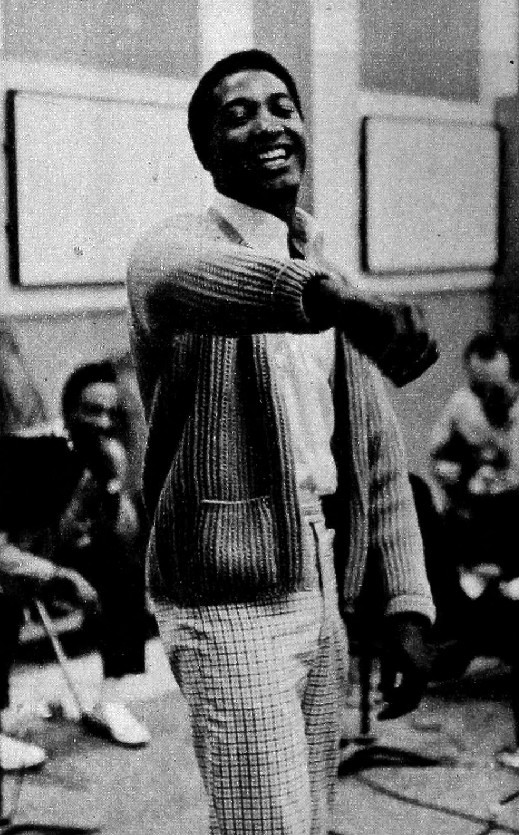
- Sam Cooke in the recording studio, 1961: Macfadden Publications (TV-Radio Mirror), Public domain, via Wikimedia Commons.
- Sam Cooke Mississippi Blues Trail marker, Clarksdale, 2018: Chillin662, CC BY-SA 4.0, via Wikimedia Commons.
- Sam Cooke's outfit at the Rock and Roll Hall of Fame, 2014: Sam Howzit, CC BY 2.0, via Wikimedia Commons.
Comments
Post a Comment