Twenty-nine years ago this week, a Canadian singer released a ballad that almost didn't make it into the movie it was written for. The director of Titanic did not want a pop song anywhere near his tragedy, the singer did not want to record it and the composer had to sneak a demo past both of them. A few months later, "My Heart Will Go On" was the best-selling single of 1998 worldwide, with an Oscar on the way and four Grammys to follow. It is a song so familiar that it can be hard to hear, so let's slow down and listen to how it was built and why it still lands. Song Facts Artist Celine Dion Released November 24, 1997 (international single); early 1998 in the United States Album Titanic: Music from the Motion Picture and Let's Talk About Love (both 1997) Written by James Horner (music) and Will Jennings (lyrics) Produced by Walter Afanasieff, James Horner and Simon Franglen Recorded 1997, at the Hit Factory in New York and WallyWorld in San Rafael, Cal...
Four chords, played clean and then played as loud as an amplifier allows. That is most of the musical recipe behind "Smells Like Teen Spirit," and yet in late 1991 it was enough to knock the glossy hard rock of the 1980s off the radio almost overnight. A trio from a logging town in Washington state had set out, by their singer's own admission, to borrow a trick from a band they loved and write a perfect pop song. What they made instead became the sound of a generation that did not want to be called a generation, and it still lands with the same jolt more than three decades later.
Song Facts
| Artist | Nirvana |
| Released | September 10, 1991 (U.S. single; sent to radio on August 27, 1991) |
| Album | Nevermind (DGC Records, 1991) |
| Written by | Kurt Cobain, Krist Novoselic and Dave Grohl (lyrics by Cobain) |
| Produced by | Butch Vig and Nirvana |
| Recorded | May 1991, Sound City Studios, Van Nuys, California |
| Genre | Grunge, alternative rock |
| Length | 5:01 (album version); 4:38 (single edit) |
| Peak Chart Positions | No. 6 on the Billboard Hot 100; No. 1 on Billboard Modern Rock Tracks; No. 7 in the UK; No. 1 in Belgium, France, New Zealand and Spain |
What the Song Is Really Saying
Ask ten fans what "Smells Like Teen Spirit" is about and you may get ten answers, which is part of the point. Kurt Cobain wrote the words in fragments, stacking images that sound like slogans, jokes and shrugs rather than a story. The chorus then erupts into a list of contradictions that feels less like a message than a mood: restless, sarcastic and a little embarrassed by its own volume.
One reading, offered by Kerrang! among others, hears the song as an ambivalent portrait of the indie-rock crowd Cobain lived among in Olympia, Washington. In that view he is poking fun at a scene that prized revolution as a pose while sitting around waiting to be amused. The narrator is not above it all, either. He admits to feeling foolish, forgets what he was trying to say and finally gives up on the whole idea of having a point.
A second reading treats the song as a portrait of youth culture at large around 1991, a generation raised on television and marketing and suspicious of both. That interpretation made it an anthem, and it is the one that stuck in the media. The irony is that Cobain distrusted anthems. He was famously uneasy with the label "spokesman for a generation," and the song itself seems to mock the very idea of a crowd demanding to be entertained.
The notoriously hard-to-decipher delivery adds a third layer. Cobain sang with a slurred, half-swallowed phrasing that made the words feel less important than the sound of frustration. "Weird Al" Yankovic built an entire parody around that mumble a year later, and Cobain gave him permission to do it. The joke landed because fans could shout the chorus without being sure what it meant.
We do not reprint the lyrics here. To read them in full and hear the song as it was meant to be heard, try the official versions on Apple Music or Spotify, or visit Nirvana's official website.
The Story Behind the Song
The title began as graffiti. In 1990, after a long night out in Olympia, Kathleen Hanna of the punk band Bikini Kill wrote a line on Cobain's apartment wall saying that he smelled like Teen Spirit. She meant it as a tease. Teen Spirit was a deodorant marketed to teenage girls, and Hanna and her Bikini Kill bandmate Tobi Vail, Cobain's then-girlfriend, had been joking about it. Cobain took the phrase as a rebellious slogan. According to several accounts, he did not learn that it referred to a deodorant until months after the single came out.
The music came together in the spring of 1991, shortly before Nirvana headed to California to make its first major-label album. Cobain later said he was trying to write the ultimate pop song and freely admitted that he was imitating the Pixies, the Boston band famous for lurching between quiet verses and explosive choruses. Krist Novoselic reportedly worried that the result sounded too close to its model. Cobain also acknowledged to Rolling Stone that the riff resembled "Louie Louie," the garage-rock standard every Northwest band seemed to know. Nirvana played the song live for the first time on April 17, 1991, at the OK Hotel, an all-ages club in Seattle's Pioneer Square.
Two weeks later, on April 30, the band signed with DGC Records. In May, Nirvana went into Sound City Studios in Van Nuys with producer Butch Vig. The band had picked Sound City partly because its rates were affordable, but Vig prized its big live room and its Neve console. He called it a perfect room for drums, and Dave Grohl, who had joined only the previous fall, made the most of it. His part was deliberately simple in the verses and thunderous in the chorus. Vig placed two room microphones well back from the kit and credited them as the secret behind the drum sound.
The band nailed the backing track quickly, keeping the second of three takes. Cobain resisted double-tracking his vocals, which he considered a form of cheating, but he sang so consistently that Vig could layer his takes anyway. DGC sent the song to stations on August 27, 1991, released the single in September and issued Nevermind on September 24. The video, directed by Samuel Bayer in his first music-video job, was shot on August 17 at a Culver City soundstage. It turned a high school pep rally into a riot of moshing students and premiered on MTV's 120 Minutes before moving into heavy rotation. By January 11, 1992, the single had climbed to No. 6 on the Billboard Hot 100. That same week, Nevermind pushed Michael Jackson's Dangerous out of the top spot on the Billboard 200.

The Artist
Nirvana formed in Aberdeen, Washington, in 1987, when Kurt Cobain and bassist Krist Novoselic started playing together in a rainy timber town about two hours southwest of Seattle. The band released its debut album, Bleach, on the Seattle independent label Sub Pop in 1989. Nirvana cycled through several drummers before Dave Grohl, formerly of the Washington, D.C., punk band Scream, joined in the fall of 1990.
Nevermind made Nirvana the biggest rock band in the world almost by accident. The album went on to sell more than 30 million copies worldwide and is widely credited with ending the reign of hair metal on mainstream radio. The follow-up, In Utero (1993), topped the charts in the United States and the United Kingdom. Cobain struggled with fame from the start, and he died in April 1994 at age 27. The band ended with him. MTV Unplugged in New York, released later that year, won a Grammy. Grohl went on to found the Foo Fighters. Nirvana, which has sold more than 75 million records, entered the Rock and Roll Hall of Fame in 2014, its first year of eligibility.

Awards and Records
- Grammy nominations: The song was nominated for Best Hard Rock Performance with Vocal and Best Rock Song. It lost the songwriting award to Eric Clapton, a result Entertainment Weekly later counted among the biggest upsets in Grammy history.
- MTV Video Music Awards: In 1992, the video won Best New Artist in a Video and Best Alternative Video.
- Grammy Hall of Fame: The recording was inducted in 2017.
- Rock and Roll Hall of Fame: In 1997, the song was named one of "The Songs That Shaped Rock and Roll."
- Rolling Stone: It ranked No. 5 on the magazine's 2021 list of the 500 Greatest Songs of All Time and No. 1 on its 2019 list of the best songs of the 1990s.
- Certifications: The RIAA certified the single Diamond for 10 million units in the United States, and the BPI certified it 5x Platinum in the United Kingdom.
- Streaming and video: In 2019, it became only the second 1990s music video to reach one billion YouTube views, after Guns N' Roses' "November Rain." It passed two billion views in June 2025.
Covers and Remakes
Few rock songs have been reinvented in so many unlikely styles. Tori Amos stripped it down to solo piano for the B-side of her 1992 single "Crucify," turning the roar into something haunted and intimate. The same year, "Weird Al" Yankovic released "Smells Like Nirvana," a parody of the band's mumbled vocals that Cobain had approved in advance. In 2005, Paul Anka gave it a big-band swing arrangement on his album Rock Swings, a version Rolling Stone later included on its list of the most unlikely covers of the song.
Punk pioneer Patti Smith recorded a slow, string-band version for her 2007 covers album Twelve, featuring banjo and fiddle. The song has also turned up as a barbershop quartet in the 2011 film The Muppets and as a moody, slowed-down cover by Malia J over the opening credits of Marvel's Black Widow (2021).
Legacy and Influence
"Smells Like Teen Spirit" did more than give Nirvana a hit. It opened the doors of radio and MTV to an entire wave of alternative bands, from Pearl Jam and Soundgarden to the many groups that followed in the mid-1990s. The song's quiet-loud structure became a template that rock bands are still using, and Grohl's drum part remains one of the first things young drummers try to learn.
It also changed the image of a rock star. Cobain was not a swaggering frontman but an awkward, funny, wounded outsider, and the song made that kind of honesty commercially viable. Lists from Rolling Stone, NME and Kerrang! regularly place it at or near the top of the greatest songs ever recorded. Turn it up, wait through those first clean guitar strums, and let the chorus hit you the way it hit the world in 1991.
Sources
- Nirvana debuts brand-new grunge-rock anthem "Smells Like Teen Spirit" at Seattle's OK Hotel all-ages club on April 17, 1991 (HistoryLink.org)
- Smells Like Nirvana (GRAMMY.com)
- Nirvana: The story behind Smells Like Teen Spirit (Kerrang!)
- "We've got a new drummer, his name is Dave, he's the best drummer in the world!": How Dave Grohl delivered the incredible Smells Like Teen Spirit drum track (MusicRadar)
- The 13 Most Unlikely Covers of 'Smells Like Teen Spirit' (Rolling Stone)
Image Credits
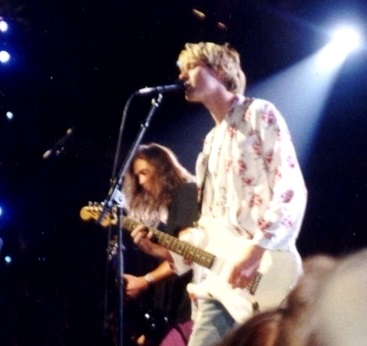
- Kurt Cobain and Krist Novoselic at the 1992 MTV Video Music Awards: P.B. Rage, CC BY-SA 2.0, via Wikimedia Commons.
- Kurt Cobain guitar at the EMP Museum: Razvan Orendovici, CC BY 2.0, via Wikimedia Commons.
- Welcome to Aberdeen sign: Jay Thompson, CC BY-SA 2.0, via Wikimedia Commons.
Comments
Post a Comment