Twenty-nine years ago this week, a Canadian singer released a ballad that almost didn't make it into the movie it was written for. The director of Titanic did not want a pop song anywhere near his tragedy, the singer did not want to record it and the composer had to sneak a demo past both of them. A few months later, "My Heart Will Go On" was the best-selling single of 1998 worldwide, with an Oscar on the way and four Grammys to follow. It is a song so familiar that it can be hard to hear, so let's slow down and listen to how it was built and why it still lands. Song Facts Artist Celine Dion Released November 24, 1997 (international single); early 1998 in the United States Album Titanic: Music from the Motion Picture and Let's Talk About Love (both 1997) Written by James Horner (music) and Will Jennings (lyrics) Produced by Walter Afanasieff, James Horner and Simon Franglen Recorded 1997, at the Hit Factory in New York and WallyWorld in San Rafael, Cal...
Every other song on Uprising is built on a full reggae band, with bass, drums, keyboards and harmony singers. Then the needle reaches the final track and almost everything disappears. There is only a man, an acoustic guitar and a voice that sounds closer to a campfire than a stadium. "Redemption Song" was the last song on the last album Bob Marley released in his lifetime, and it has come to feel like his farewell letter: a quiet call to free the mind, written by a man who was already fighting for his life.
Song Facts
| Artist | Bob Marley & The Wailers (album version performed by Marley alone) |
| Released | June 10, 1980 (album); later issued as a single |
| Album | Uprising (Island Records) |
| Written by | Bob Marley |
| Produced by | Bob Marley & The Wailers, with Chris Blackwell |
| Genre | Acoustic folk ballad |
| Length | 3:49 |
| Recognition | No. 42 on Rolling Stone's 500 Greatest Songs of All Time (2021) |

What the Song Is Really Saying
The song opens in the hold of a ship. In the first verse, the narrator remembers being stolen from his home and sold into bondage, then lifted up by a strength he credits to God. It is a compressed history of the transatlantic slave trade told in the first person, as if the singer had lived it himself, and in a sense every descendant of the enslaved has.
Then the second verse turns from the past to the present. It does not ask anyone to take up weapons; it asks listeners to free themselves from the slavery that lives inside the mind, because no one else can do that work for them. The same verse then widens the lens to fear itself. The singer tells listeners not to be afraid of atomic energy, and he asks how long people will go on murdering their prophets while bystanders do nothing.
Between the verses, the chorus offers the singer's own contribution: a freedom song, handed to the listener as an invitation to join in. That gesture is the key to the whole piece. "Redemption Song" is not a sermon delivered from above. It is a tool passed from one person to another, and the plain guitar arrangement makes it easy to pick up and carry.
The central idea was not new, and Marley never pretended it was. In October 1937, the Jamaican activist Marcus Garvey gave a speech in Sydney, Nova Scotia, arguing that while others might free a person's body, only that person could free his or her own mind. The speech was later printed in Garvey's magazine, Black Man. Garvey was a towering figure in Rastafari thought, and Marley turned his words into a few unforgettable lines that millions of people now know by heart.
You can read the full lyrics on licensed services such as Apple Music or Spotify, or visit the official Bob Marley website.
The Story Behind the Song
By the time Marley wrote "Redemption Song" in the late 1970s, he was carrying a secret weight. In 1977, doctors had found a malignant melanoma under the nail of one of his toes. They recommended amputation, but Marley declined for religious reasons and had only the nail and nail bed removed. He kept recording and touring at a punishing pace. His wife, Rita Marley, later said he was often in severe pain during this period and that thoughts of his own mortality found their way into his writing, especially in this song.
Marley first cut the song several times as a full-band arrangement with The Wailers. It was Chris Blackwell, the founder of Island Records, who suggested something radically different: strip it down to Marley's voice and guitar, like a folk song. Marley agreed. The result sounded like nothing else in his catalog, and he seemed to recognize that. In its 2021 list of the greatest songs, Rolling Stone quoted Marley as saying, a few months before his death, that he would love to do more like it.
Uprising arrived on June 10, 1980, with the upbeat "Could You Be Loved" as its lead single and "Redemption Song" placed at the very end, like a closing prayer. Two weeks before the album came out, Marley and The Wailers had launched the Uprising Tour in Europe, opening in Zurich on May 30 and playing to some of the biggest crowds of their career. On June 7, they played the Crystal Palace Bowl in London, a show that proved to be the band's largest UK concert and its final London performance.
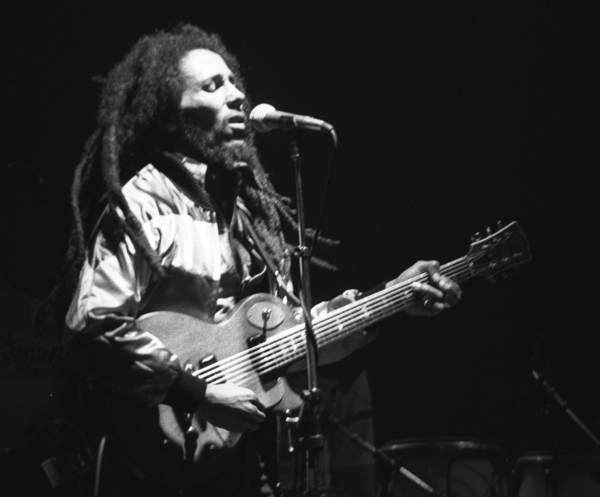
The American leg of the tour began that September, but Marley's body was giving out. On September 21, 1980, after shows at Madison Square Garden, he collapsed while jogging in New York's Central Park. Doctors found that the cancer had spread to his brain, lungs and liver. Two days later, on September 23, he walked onto the stage of the Stanley Theatre in Pittsburgh for what would be his final concert. "Redemption Song" was part of the set that night, and the show was eventually released as the live album Live Forever. The rest of the tour was canceled.
The Artist
Robert Nesta Marley was born on February 6, 1945, in the village of Nine Mile in Saint Ann Parish, Jamaica. His mother was a young Black Jamaican woman and his father a much older white Jamaican, and Marley grew up poor, eventually settling in the Kingston neighborhood of Trench Town. In 1963, he formed The Wailers with Peter Tosh and Bunny Wailer, and the group spent the next decade building a following in Jamaica before signing with Island Records and reaching the rest of the world in the early 1970s.
Marley became far more than a pop star. As a devout follower of Rastafari, he sang about faith, poverty, injustice and African unity, and his music became a voice for people who rarely heard themselves on the radio. On December 3, 1976, gunmen attacked his home in Kingston, wounding Marley, Rita and his manager, Don Taylor. Two days later, he performed anyway at the Smile Jamaica concert. In 1978, he returned from exile in London to headline the One Love Peace Concert in Kingston, and in April 1980 he was invited to perform at the celebrations marking Zimbabwe's independence.
After his collapse in New York, Marley sought treatment at the clinic of Dr. Josef Issels in Bavaria, Germany, but the cancer could not be stopped. In February 1981, Jamaica awarded him the Order of Merit. He died in a Miami hospital on May 11, 1981, at the age of 36, while trying to make his way home. Ten days later, Jamaica gave him a state funeral.
Awards and Records
- Last word on the last album: "Redemption Song" closes Uprising, the final studio album Marley released during his lifetime.
- Final single: It was the last single released before Marley's death in 1981.
- Rolling Stone: It ranked No. 42 on the magazine's 2021 list of the 500 Greatest Songs of All Time.
- A late music video: In February 2020, to mark the song's 40th anniversary and what would have been Marley's 75th birthday, his estate released an animated video by French artists Octave Marsal and Theo De Gueltzl, made from 2,747 original drawings.
- Career honors: Marley was inducted into the Rock and Roll Hall of Fame in 1994 and received a Grammy Lifetime Achievement Award in 2001. His 1984 compilation Legend became the best-selling reggae album of all time.
Covers and Remakes
Because it needs nothing more than a guitar, "Redemption Song" has become one of the most covered songs in Marley's catalog. Bob Geldof sang it at the closing concert of Amnesty International's Conspiracy of Hope tour at Giants Stadium in New Jersey in 1986, and Stevie Wonder later recorded his own soulful version. Joe Strummer, the former frontman of The Clash, recorded a stripped-down version with producer Rick Rubin for Streetcore, his final album with The Mescaleros, released in 2003 after his death.
Strummer also recorded a duet of the song with Johnny Cash during Cash's sessions with producer Rick Rubin. The pairing of a British punk icon and an American country legend singing a Jamaican freedom song came out in 2003 on Cash's box set Unearthed. In January 2010, Rihanna performed an acoustic version on The Oprah Winfrey Show after the earthquake in Haiti and made it available as a download to raise money for relief efforts.
Legacy and Influence
Few songs have been asked to carry as much as this one. It is sung at protests and memorials and quoted by activists around the world. In James Henke's book Marley Legend, Bono recalled carrying the song with him to meetings with politicians and heads of state, and he described it as "a prophetic utterance." For many listeners, it has become an anthem for anyone trying to shake off an inherited sense of limitation.

Its power comes partly from its timing. Listeners who hear it today know what Marley may only have suspected when he recorded it: that he had little more than a year left to live. That knowledge turns a simple folk song into something like a last will, and it makes the invitation in the chorus feel even more personal. Marley did not leave instructions for how to remember him. He left a song and asked everyone listening to join in.
More than four decades later, the song still sounds unfinished in the best possible way, as if it were waiting for the next voice to take it up. Find a quiet moment, put on the solo version from Uprising, and listen to how much freedom one man and one guitar can hold.
Sources
- uDiscover Music: "Redemption Song": The Story Behind Bob Marley's Timeless Anthem
- The Canadian Encyclopedia: The African Nova Scotian Roots of Bob Marley's "Redemption Song"
- American Songwriter: Behind the Song: Bob Marley, "Redemption Song"
- JamBase: Bob Marley Performs Final Concert on This Date in 1980
- Open Culture: Bob Marley's "Redemption Song" Finally Gets an Official Video: Watch the Animated Video Made Up of 2747 Drawings
Image Credits
- Bob Marley at Dalymount Park, Dublin, 1980: Eddie Mallin, CC BY 2.0, via Wikimedia Commons.
- Bob Marley in Zurich, 1980: Ueli Frey, CC BY-SA 3.0, via Wikimedia Commons.
- Crystal Palace Bowl plaque, 2023: Spudgun67, CC BY-SA 4.0, via Wikimedia Commons.
Comments
Post a Comment